

Poople
Transform four-letter words into POOP by swapping one letter per turn. Test your vocabulary, dodge dead ends, and solve daily word ladder puzzles online.
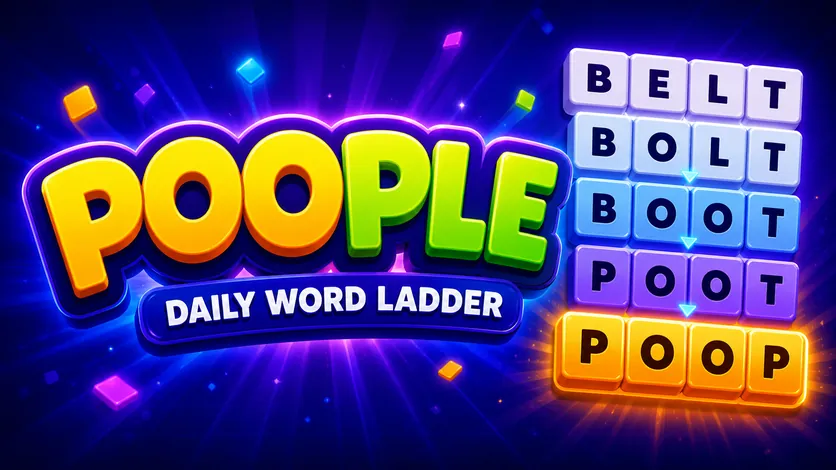
Poople is a daily word ladder puzzle that challenges you to transform a given four-letter starting word into POOP by changing exactly one letter at a time. Every intermediate submission must be an authentic English word with exactly four letters, turning each puzzle into a tactical pathfinding challenge between two vocabulary points.
About Poople
Poople is a daily word ladder puzzle where the objective is to connect two words through a chain of valid single-letter substitutions. While conventional word games conceal the target solution, Poople reveals the ending word POOP at the outset. Your challenge centers on plotting the most direct trajectory from the randomized daily starting word to the finish line.
The game features two dedicated play modes: the Daily Challenge and Unlimited Practice Mode. In the Daily Challenge, all players worldwide receive the identical starting word, competing to match or beat the par move count while building consecutive daily win streaks. Unlimited Practice Mode generates infinite random four-letter starting boards with no timers, allowing you to refine vocabulary pathways and test transition strategies at your own pace.
How to Play Poople
Each round presents a starting four-letter word and the ultimate destination: POOP. On your turn, submit another four-letter word that modifies exactly one character from the current word. You cannot rearrange letters, remove characters, or expand beyond the four-letter boundary.
As you build the sequence, evaluate how each candidate word bridges toward the final target. For example, moving from BOOK might lead to COOK, which then transitions to COOP, leaving only the first letter to swap into POOP. Each valid entry becomes the next step on the ladder. If a route reaches a dead end with no viable one-letter continuations, you can backtrack and explore alternative branches.
The round concludes once you enter POOP. An end-of-game summary displays your total move count alongside the optimal minimum path, updating your streak records and performance statistics.
Tips for Poople
Work backward from POOP
Identify words that sit one letter away from the target, such as COOP, LOOP, POLE, or POOR, and aim your opening chain toward these gateway words.Favor flexible vowel transitions
Select words with versatile letter combinations that maintain multiple valid substitution options instead of committing to rare consonants.Check single-letter validity before submitting
Verify that only one letter has changed between consecutive rows, as entering words with two altered letters invalidates the move.Abandon trapped routes promptly
Backtracking early saves steps compared to extending a dead-end sequence that drifts further from the target word.
Game Controls
- Keyboard - Type a valid four-letter word.
- Enter - Submit the current word.
- Left mouse button - Tap on-screen letters and menu buttons.
FAQ
What is the goal in Poople?
Transform the four-letter starting word into POOP by changing one letter per move, keeping every entry a valid English word while using as few moves as possible.
How is Poople different from Wordle?
Wordle requires guessing a secret target word through colored tile clues. Poople displays the target word POOP from the beginning, focusing the challenge on constructing an optimal word ladder path.
Does Poople include unlimited puzzles?
Yes. In addition to the shared Daily Challenge, you can switch to Unlimited Mode to play as many practice puzzles as you want.
Can you rearrange letters during a turn?
No. Every move must maintain the exact letter positions of unchanged characters; anagrams and letter swaps are not permitted.
Similar Games to Try
- Wordle Unlimited - Guess the hidden five-letter mystery word with color-coded feedback and infinite replay.
- Dordle - Solve two Wordle-style puzzle boards simultaneously with a shared set of word guesses.
- Quordle - Push your vocabulary deduction further by solving four concurrent word grids in nine attempts.